
by Sian Murphy – Knisco Inclusive Access
 Sian Murphy is a senior access consultant at Knisco Inclusive Access, based in Brisbane, Queensland. Sian began her career in architecture, specialising in the heritage sector, before discovering her passion for accessibility within the built environment.
When I became a mother, I expected to be faced with many new challenges. What I did not anticipate was how difficult it would be to find somewhere safe and hygienic to change my baby when I left the house.
Repeatedly, I would ask for a baby change table only to be told there wasn’t one. I became accustomed to changing my son on a bathroom floor, on a park bench, in the pram, or in the boot of my car. None of these options are safe, dignified, or hygienic. They also do not make a new parent feel welcomed or included in public life.
After speaking with friends and family, I realise mine is not an uncommon experience.
Under the Building Code of Australia, there are currently mandatory provisions for male, female, ambulant, unisex accessible, accessible adult change facilities, and most recently (to be adopted under BCA 2025), all gender facilities. However, there is still no mandatory requirement for the provision of baby change facilities or toilets designed for young children. If access to sanitary facilities is considered fundamental to public health, why are infants, young children and their carers still overlooked in our building legislation?
Fortunately, many building owners do provide baby change tables, and some include well-designed parents’ rooms. However, provision is inconsistent. Access to baby change facilities depends on goodwill rather than obligation. As a result, location, quantity, quality, and amenities vary greatly.
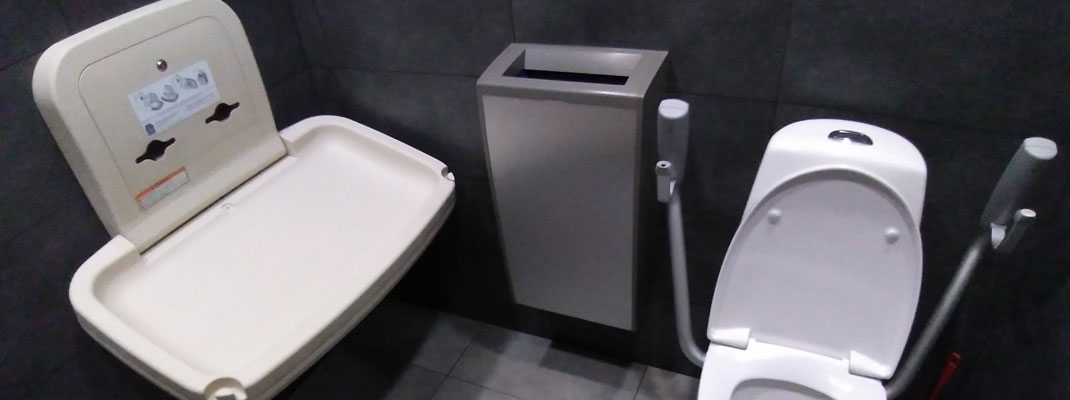
More often than not, baby change tables are installed within unisex accessible sanitary facilities. While this is of course preferable to no provision at all, it creates challenges for other users of these facilities. Unisex accessible sanitary facilities serve a critical function for people with disability. When a baby change table is located inside, these rooms are often occupied for extended periods while parents grapple with the difficulties of changing infants and young children. This can delay access for someone with a disability who may require the facility, potentially causing distress, medical complications, and loss of dignity. Baby change tables can also impact on the accessibility of the rooms, by encroaching into critical circulation space. Accessible sanitary facilities are already limited in number and making them multifunctional places additional strain on them.
Another common scenario is locating baby change tables exclusively within female bathrooms. This reinforces outdated gender norms that position caregiving as a women’s responsibility. Fathers and male carers are frequently left without access, forced to improvise or ask women for assistance.
The absence of baby change facilities also sends a broader social message – caring for children is a private, domestic task that should occur at home, not something supported or accommodated in public life. As a new mother, this message was subtle but persistent.
Yet there are enormous social benefits to supporting families to participate fully in community life. Leaving the house with a baby promotes social connection, supports parental mental health, contributes to early childhood development, and has added economic benefits. But the simple uncertainty in finding a suitable location to change a baby adds unnecessary stress to what can already be an overwhelming experience.
This is why I believe an amendment to the Building Code of Australia should be considered to mandate appropriately designed baby change and family facilities in key public buildings.
Baby change facilities should not be an afterthought or a compromise. They should be:
- Required in new public buildings above a defined size or classification.
- Located outside gendered spaces and separate from unisex accessible sanitary facilities. For example, in dedicated family rooms.
- Where they are located within gendered spaces, they should be provided in all locations – male, female, and unisex accessible.
- Inclusive of broader child-friendly design considerations – for example, appropriate pan heights for children, cubicle sizes that accommodate prams, and separation where required.
- Clearly signed and easy to locate.
In recent years, Australia has made significant progress in accessibility, equity, and universal design. However, infants, young children, and the adults who care for them remain largely invisible within our building legislation.
This is not about luxury and convenience. It is about dignity, inclusion, and recognising that modern families are an integral part of our communities. If we are serious about inclusive design, then our buildings must reflect the reality of the people who use them, including the smallest among us.