
 by Dean Homicki
Industry Pioneer of TGSI | Founder, Stæbl Academy
Member, Access Consultants Association (ACA
Dean Homicki is an industry pioneer of Tactile Ground Surface Indicator (TGSI) systems and the founder of Stæbl Academy. With more than 25 years of experience in mobility access products, design systems, and professional education, he works across manufacturing, specification, and construction cultures to strengthen accessibility outcomes. Dean is a member of the Access Consultants Association, ACA.
Recently, a media report described a person sustaining serious injury after slipping on tactile ground surface indicators, known as TGSIs.
Whenever accessibility infrastructure is implicated in an incident, many of us feel two things at once. First, concern for the person who has been injured. Second, concern for what the incident means for the integrity of the accessibility system itself.
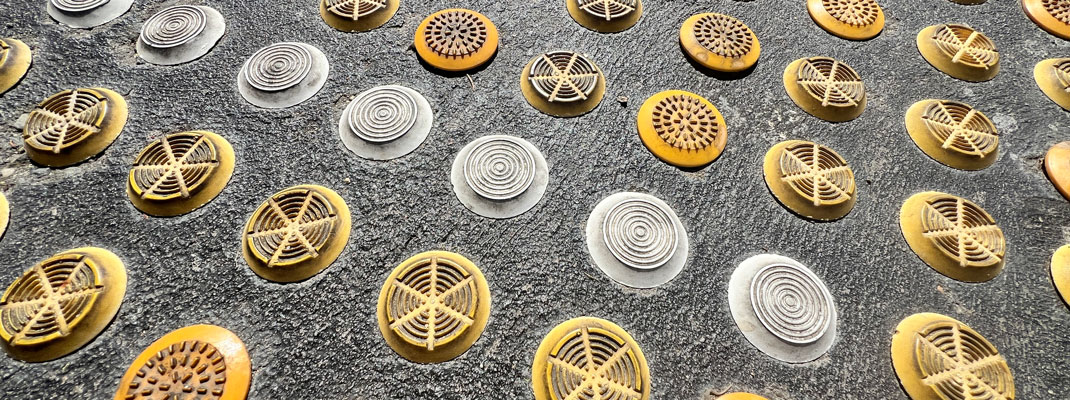
TGSIs are sometimes mistaken for decorative surface treatments. They are not. They are orientation and mobility devices designed to provide critical environmental cues for people who are blind or have low vision. For many members of our community, these surfaces form part of a navigational language that supports independent travel.
When an incident occurs, the immediate public question is often simple: Why did someone slip?
As professionals working in accessibility, we are called to ask a more complex and responsible question: Was the accessibility infrastructure properly specified, installed, and maintained for the environment in which it was placed?
The Dual Duty of Care
Accessibility infrastructure carries a dual duty of care.
First, it must perform its intended function, providing reliable tactile and visual cues for people who rely on them for safe orientation and mobility.
Second, it must remain safe for the broader public under reasonably foreseeable conditions, including wet weather, contamination, wear, and variations in use.
These duties are inseparable.
If TGSIs are overly smooth, incorrectly profiled, poorly fixed, contaminated, or inadequately maintained, they can become hazardous. Conversely, if their tactile or visual performance is compromised, they fail the very people they are intended to serve.This is not a design dilemma. It is a systems question.
What We Often Do Not Know
In many reported incidents, the full context is unclear. Environmental conditions matter.
Was the surface wet? Was there debris, leaf litter, oil contamination, or biological growth? Was glare affecting visual contrast? Was the surrounding substrate compliant and level?
Human factors also influence slip events.
Footwear, load carriage, distraction, gait variability, and behavioural response can all play a role.
Beyond individual behaviour or environmental variables, there are deeper professional considerations:
* Was the correct TGSI product selected for the specific environment?
* Was its slip resistance classification appropriate for both wet and dry conditions?
* Was the product independently tested in accordance with relevant Australian Standards?
* Were installation instructions followed precisely, including substrate preparation and fixing methodology?
* Was the installation formally inspected and signed off?
* Has a documented maintenance regime been established and implemented?
* Has performance, including slip resistance and luminance contrast, been monitored over time?
These are not questions of blame. They are questions of governance.
Compliance Is the Starting Point
In Australia and New Zealand, AS/NZS 1428.4.1 provides technical guidance for the design and application of TGSIs. It establishes dimensional, layout, and performance expectations intended to create consistency across the built environment.
However, compliance with the standard should not be regarded as the finish line.
Standards describe minimum benchmarks. Real-world environments are dynamic. Surfaces age. Adhesives degrade. Substrates shift. Maintenance regimes vary. Public use patterns change.
An installation that met all requirements at practical completion may not perform identically five years later without inspection and maintenance. Accessibility infrastructure is not static. It requires lifecycle thinking.
The Supply Chain as a System
When something goes wrong, it is rarely the result of a single isolated decision. More often, it reflects a breakdown across a chain of responsibility, the designer’s specification, the manufacturer’s testing and documentation, the supplier’s representation of performance, the installer’s workmanship, and the asset owner’s maintenance program.
If any link in this chain is weak, the system as a whole is vulnerable.
The access consulting profession occupies a critical position within this system. It sits at the intersection of regulation, design intent, user experience, and built outcome. This role requires technical literacy, independence, and cultural leadership.
Incidents, however regrettable, offer an opportunity to reflect on how effectively the system is functioning.
Luminance Contrast and Slip Resistance Over Time
Two technical aspects of TGSIs warrant particular attention in ongoing performance assessment: slip resistance and luminance contrast.
Slip resistance classification at the point of supply is essential. Yet contamination, wear, surface polishing from pedestrian traffic, or inappropriate cleaning regimes can alter performance over time. Periodic review is prudent in high-traffic or exposed locations.
Similarly, luminance contrast, critical for people with low vision, can degrade due to fading, surface abrasion, or changes to surrounding finishes. Alterations to adjacent surfaces may unintentionally reduce contrast below acceptable thresholds.
Monitoring these factors is not merely technical diligence. It supports the intent of the Disability Discrimination Act 1992 (Commonwealth) and the performance requirements of the National Construction Code. Accessibility must remain functional, not simply compliant on paper.
Cultural Maturity in Construction
The construction and civil infrastructure environments are complex and often fragmented. Multiple subcontractors, procurement pressures, and compressed timelines can obscure clarity of responsibility.
Accessibility infrastructure deserves the same disciplined systems thinking applied to structural integrity, fire safety, and essential services.
Cultural maturity in construction means recognising that mobility access products are functional, safe mobility and orientation devices embedded within the public realm.
When these elements are specified, inspected, or certified, they shape environments that people trust, sometimes with their physical safety.
Professional reflection invites us to ask:
* Are documentation processes sufficiently rigorous?
* Are product substitutions scrutinised?
* Are installation tolerances verified?
* Is maintenance guidance practical and realistically implemented?
These questions strengthen the profession.
Moving Forward Constructively
Isolated incidents can generate polarised commentary, with criticism of accessibility measures on one side and defensive protection on the other.
A more constructive response is possible.
* We can acknowledge injury with empathy.
* We can recognise public concern without dismissing it.
* We can respond by strengthening systems, documentation, and lifecycle oversight.
For people who are blind or have low vision, TGSIs support independence. Their reliability and consistency across cities and regions builds trust. Inconsistent quality and material integrity undermine that trust.
For the broader community, safety under expected conditions must be assured. For our profession, credibility rests on evidence-based practice and transparent accountability.
A Shared Professional Responsibility
As members of the Access Consultants Association, we form part of a national professional body advancing equity in the built environment. With more than 900 members across multiple disciplines, our collective influence is substantial.
Each project presents an opportunity to model best practice.
When accessibility infrastructure is questioned, our role is neither blind defence nor reflexive criticism. It is careful examination, informed inquiry, and commitment to improvement. Accessibility works when design intent, product performance, installation integrity, and maintenance discipline align.
If incidents prompt stronger alignment, then reflection becomes progress. And steady, professional, evidence-based progress is what the people we serve deserve.