
 by Daniel Bedwell
Daniel Bedwell is an Accredited Access Consultant, Ordinary Committee Member with the Access Consultants Association – ACA, and Director of Obvius Access Consultants.
Aquatic Centres are an example of a highly functional space which aims to meet the needs of the widest range of people in the design, operation and maintenance. An aquatic centre is a dynamic environment, which includes the requirements of all people in society including families with young children, older people, people of all sensory, cognitive, mobility abilities, all gender and neurodiversity.
Inclusive design is a continuous process, spanning from concept and design brief to master plan, detailed design, and construction milestones.
Accessibility Overlay Maps
In the early design process, an accessibility overlay serves as method for identifying accessible features during the initial concept phase for aquatic centres. For instance, overlay site maps can illustrate pedestrian access pathways from designated accessible parking areas to primary entrances and related amenities.
They may also provide information regarding the location of changing rooms, sanitary facilities, and showers, which should be situated as close as possible to the accessible pool entry point—specifically, the ramp entry. This provision could minimise fatigue and discomfort for people with disabilities and some older people.
Therefore, an overlay map should reflect the complexity and size of the aquatic facility, and include the following points as a reference. These points are simple examples rather than a comprehensive list to illustrate some of the components that could be identified from the outset:
- Accessible transport such as bus stops/transport hubs, etc.
- Accessible car parking locations.
- Set down/drop off areas for accessible public transport, community vehicles, and coaches etc., (dependent on the size of the facility).
- The width of primary pathways and secondary pathways colour coded.
- Gradients of pathways colour coded based on grade.
- Rest areas and drinking fountains (dependent on the size of the facility).
- Equivalent arrival experience, i.e. ramps, walkways, stairs and lifts (if provided) and their context to the building entrance.
- Distances to changing rooms and facilities from the building entry point.
- Pool ramp locations or means of pool entry and their distance to changing rooms and sanitary facilities.
Planning early could enable the use of walkways at maximum gradients of 1:20 instead of ramps with a maximum gradient of 1:14 gradient as per AS 1428.1:2021. Walkways at 1:20 or less offer greater comfort and universal access. The provision of stairs in addition to the walkway also provide greater amenity for people with varying ambulant abilities.
Entry to Pools
The National Construction Code Part 2022 Vol 1 Part D4D11 state that not less than 1 means of accessible water/exit must be provided for each swimming pool required by D4D2. As follows:
An accessible entry/exit must be by means of—
(a) a fixed or movable ramp and an aquatic wheelchair; or
(b) a zero-depth entry and an aquatic wheelchair; or
(c) a platform swimming pool lift and an aquatic wheelchair; or
(d) a sling-style swimming pool lift.
Where a swimming pool has a perimeter of more than 70m, at least one accessible water entry/exit must be provided by a means specified in (2)(a), (b) or (c).
To adhere to best practices, multiple methods of pool access should be available. For instance, Figure 1 illustrates a standard pool hoist designed to assist people with high support requirements.
The provision of a sling or hoist is not permitted as a single form of pool entry to a pool exceeding 70m perimeter, however, it could be provided in addition to ramps and platform lifts to pools. This is for reasons that some people with high supports needs cannot use a ramp independently.
A hoist is typically used by people who use water for therapy, in which the buoyancy of the water and sling can provide respite from a mobility aid. For example, high support education facilities may have training programs in which students would use a hoist for entry to the pool, due to that fact that the person may have higher support needs and may not have the motor skills to use a ramp and stay buoyant in the water. Therefore, hoists ensure additional access to the pools for people who cannot use a ramp independently to submerge into the water.
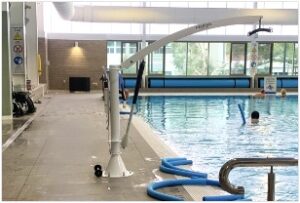
Fig 1 – Hoist compatible with sling and aquatic wheelchair
Figure 2 illustrates a pool ramp that supplements a hoist and features a shallower gradient of 1:16 to accommodate the increased resistance encountered in water. It is beneficial that ramps leading into pools do not exceed a slope of 1:16, as steeper gradients could impose excessive resistance and drag on individuals propelling aquatic wheelchairs through the water.
There could also be luminance contrast between the landing and the ramps to enhance safety. The wet deck also provides an opportunity to provide a textural and luminance contrast around the pool perimeter.
Tactile domes also, could be provided to all ramp and stair handrails in lieu of Tactile Ground Surface Indicators to pools as shown in Fig 1.
Additionally, incorporating a single step down to the bottom landing of the ramp should be avoided to facilitate a smooth transition and mitigating risks of tipping or injury. While a smooth transition may be feasible for 25m pools, entries into 50m pools often necessitate a platform ledge for pool entry due to the greater depth requirements of 50m pools. Specifically, compliance with NCC 2022 Vol 1 S16C2 (f) stipulates a bottom landing depth of 900–1100mm below the stationary water level while FINA (Federation Internationale de Natation) require a minimum depth of 1.8m throughout.
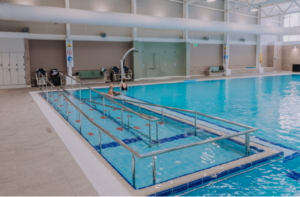
Fig 2 – Pool Ramp with a gradient shallower than 1:14 at 1:16 or shallower
A possible third way to enter a pool could be by means of stairway access, as shown in Fig 3. This type of entry is provided alongside ladder access, but the stairs have wider treads and lower steps to accommodate people with ambulant disabilities and some older people.
When stairway access is provided to pools, the ‘Going’ could measure 300mm to minimise the risk of overstepping when descending, while the ‘Riser’ could be set at 150mm. This combination enhances accessibility for all users, including older people, those with ambulant disabilities, and people with low vision. These specifications comply with the requirements established in AS 1428.2:1992 for risers and treads.
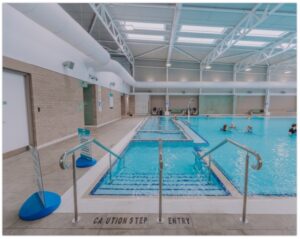
Fig 3 Stairway access to the pool with Goings and Risers complying with AS 1428.2:1992
As specified in the NCC Part D4D11 and Specification 16, a pool lift complying with the specifications of Part S16C4 could also be another consideration for pool entry to pools.
Disclaimer
This article does not provide a comprehensive list of considerations or recommendations for Aquatic Centres and should not be a technical resource or referred to in isolation without compliance with all relevant legislation. It is an opinion piece which is intended solely for consideration. Any suggestions offered represent best practices that if considered must be suited to the specific site characteristics and technical constraints of each project. Best practice recommendations for Aquatic Centres should support, and never conflict with, applicable legislation, subordinate legislation, policies, and applicable Australian Standards. The author does not accept responsibility or liability for the results of any errors or omissions based on this information nor for any errors or omissions on projects.