

by John Van der Have
John Van der Have is the principal of Bio-Building Design Pty Ltd. He is a registered architect and an accredited access consultant. He has worked on buildings of all scales, classes and types of construction.
Attention Deficit Hyperactivity Disorder (ADHD) is a neurodevelopmental condition – a disorder of early brain development. Symptoms include inattention (not being able to keep focus), hyperactivity (excess movement that is not fitting to the setting) and impulsivity (hasty acts that occur on the spur of the moment without forethought). ADHD can be a chronic and debilitating disorder and is known to impact individuals in many aspects of their lives.
According to Australia’s largest child health research organisation – the Murdoch Children’s Research Institute – ADHD affects 5% of Australian children and 3.2% of the general population (1). The actual number of people with ADHD may be higher, however, as it can often go undiagnosed.
ADHD is one of the most commonly diagnosed mental health conditions in children. Children with ADHD often have difficulty at school with concentration and completion of tasks. They may also have trouble with social interactions and with emotional regulation. Anxiety and depression are common companions to ADHD. The Murdoch Children’s Research Institute points out that 25 – 50% of children with ADHD experience anxiety.
ADHD is typically diagnosed in childhood, but can persist into adulthood. The causes of ADHD are not well understood. Treatment usually encompasses a combination of behavioural therapy and medication. Medications are typically psycho-stimulants (drugs such as amphetamines and methylphenidate). These drugs, while improving focus and attention, only treat symptoms – not underlying causes. These drugs have a high potential for addiction, over-prescription and misuse. Long term effects from such drugs are unclear, and unwanted side effects common.
Medical doctors Edward Hallowell and John Ratey, both of whom have ADHD and who have jointly authored several books on the subject, have concluded that environment is a powerful tonic – for better or for worse – in the lives of people with ADHD (2). In light of their conclusion, can buildings and spaces be designed to enhance the well-being of those with ADHD? While we don’t yet have all the answers, and much more research is needed, some directions have become apparent.
Design at an urban scale
Physical activity is of great benefit to those with ADHD (3). Such physical activity can take various forms – participation in sport, walking the dog, or simply spending time in and enjoying a natural environment. Movement acts as a natural boost for focus and mood. Exercise enhances executive function and alleviates core symptoms of ADHD.
Environmental scientists at the Department of Natural Resources and Environmental Sciences, University of Illinois, concluded that children with ADHD concentrated better after walking in a park, compared to a walk along a suburban street. They found that greater concentration rates are achieved after walking in a park. These findings indicate that environments can enhance attention in ADHD populations, leading to reduced medication intake. Such ‘doses of nature’ might serve as a safe, inexpensive and widely accessible new method in the toolkit for managing ADHD symptoms (4).

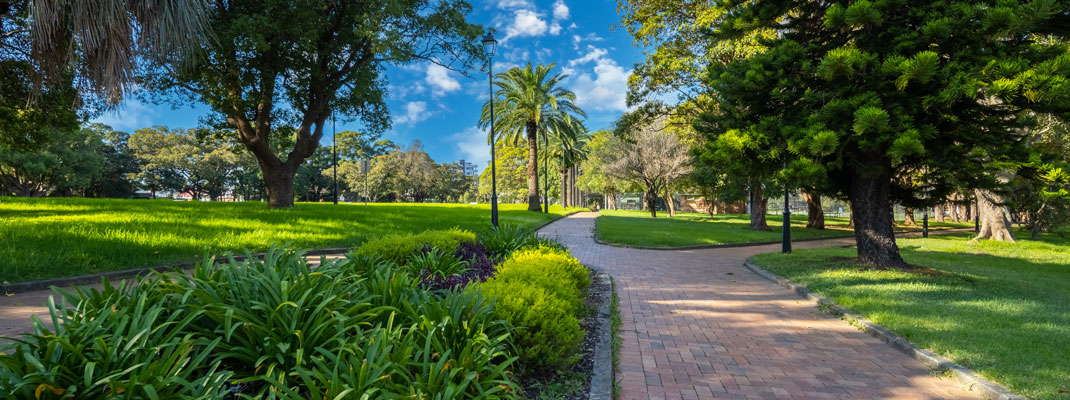
Machattie Park, Bathurst – designed in 1890 by architect James Hine with input from Alfred Machattie. Environmental scientists have concluded that parks with large established trees such as these enhance attention in people with ADHD. (Photograph: John Van der Have)
Design at a classroom scale
Children with severe neurodevelopmental conditions are increasingly being taught in mainstream schools. As a result, school administrators need to manage the resultant, and often severe, behavioural disturbances that can occur within the school environment.
ADHD can present as a ‘behavioural problem’ at school, leading to disruption in the classroom. Teacher groups have said that teachers are sometimes faced with extreme behaviour that puts them, and other students, at risk, and that disrupts learning. Teacher groups describe these problems as ‘incredibly difficult’.
On the other hand, parents’ and citizens’ groups are increasingly championing the needs of children with disabilities such as ADHD. In some schools, P&C groups have established subcommittees specifically to address the needs of these children. As a result, in many schools parents and school management are at loggerheads over how to deal with increasing numbers of problems within mainstream classrooms.
With looming changes to the National Disability Insurance Scheme, schools are likely to increasingly be required to better cater for children with ADHD and similar conditions. The ‘Thriving Kids’ program, which is to be implemented throughout Australia from October 2026, is intended to enable the needs of children with ADHD to be be catered for in schools.
Noisy, chaotic, or overly stimulating environments can overwhelm the senses of students with ADHD, triggering feelings of irritation. For individuals with ADHD, and those with autism spectrum disorder, sensory overload is a common problem. Classrooms and similar environments should ideally be calm, soothing spaces that do not negatively impact these children.
The impulse to suspend disruptive children and send them home may be understandable but is not a totally satisfactory response. Likewise, expelling such students is also not a totally satisfactory response. The Disability Standards for Education 2005, formulated under the Disability Discrimination Act 2005, require that Education Providers make reasonable adjustments in relation to the educational needs of students with disabilities.
Education Providers are required to consult with, and consider the individual requirements of, students with disabilities, including those with ADHD. School administrators generally seek to reduce suspensions and expulsions for children with disabilities such as ADHD, as far as possible.
School students with ADHD can benefit from sensory-friendly, flexible physical designs, including designated quiet zones. Distractions within such zones should be minimal. The classroom environment should be orderly and predictable, with regular routines, clear visual aids and multi-sensory learning methods. To achieve these goals collaboration between staff, parents and students is important.
In one new school project which we were involved in, a ‘withdrawal room’ was included. This was separate from, yet linked to, two adjacent classrooms by windows. These windows give children with disorders such as ADHD the option to withdraw from the main classroom space and to take a break, while still being visually connected to the teacher, other students and events happening in the classroom. This is a commendable attempt by the management of this particular school to reduce disruptions within the classroom and so reduce resultant suspensions and expulsions.
Design at a public building scale
Recently constructed leading-edge commercial buildings, such as the Quay Quarter Tower at Circular Quay, Sydney, include ‘quiet spaces’ for worker wellbeing. This building, completed in 2023, has been acclaimed for pioneering new standards in commercial building development. Similar spaces have been installed in many airports around the world in recent years.
In projects for government use, where staff are required to interface with the public in settings that can sometimes be tense or confrontational, ‘wellness rooms’ are today often provided. These go by various terms including ‘reset rooms’, ‘culturally safe rooms’, ‘sanctuary spaces’ or ‘quiet spaces’. They are restorative spaces to which individuals may retreat when they need to re-group or recover from tense situations, or simply to chill out. They are refuges, to which individuals may withdraw when needed to manage sensory overload, to restore a sense of calmness or to re-set one’s nervous system. Such spaces benefit people with ADHD, as well as others.
Many questions arise as to the interior fit out, use and management of such reset rooms, especially when the precise user profile of occupants is not known in advance (as is generally the case in public buildings). Post-occupancy evaluation of such spaces as already exist, to assess their efficacy, would be beneficial.
On a recent project involving a church premises with which we were involved, we added a playground to the existing church building. This addition of a playground was identified as being of benefit to children with ADHD, as well as to other children.
Design at a residential building scale
In the design of residences that may include children with ADHD the Australian Psychology Society recommends that quiet spaces be included where children can engage in activities such as homework. These spaces should be free from clutter, toys, electronic media, and other distractions (5).
Conclusion
Both urban design and building design have roles to play in the provision of services for people with ADHD. While the examples given above – as to how design can make a positive contribution – are starting points, much more research is required to meet the needs of the significant segment of the population with Attention Deficit Hyperactivity Disorder.
References
- Murdoch Children’s Research Institute: <mcri.edu.au> / ADHD, accessed 26.10.25
- Hallowell, EM & Ratey, J: ADHD 0, Sheldon Press, London, 2023, p 77
- Ibid pp 94-106
- Andrea F Taylor & Frances E Kuo, ‘Children with attention deficits concentrate better after walk in the park’, Journal of Attention Disorders, Vol 12, 2009, p 402
- Australian Psychological Society <psychology.org> / ADHD in Children / accessed 26.10.25)