
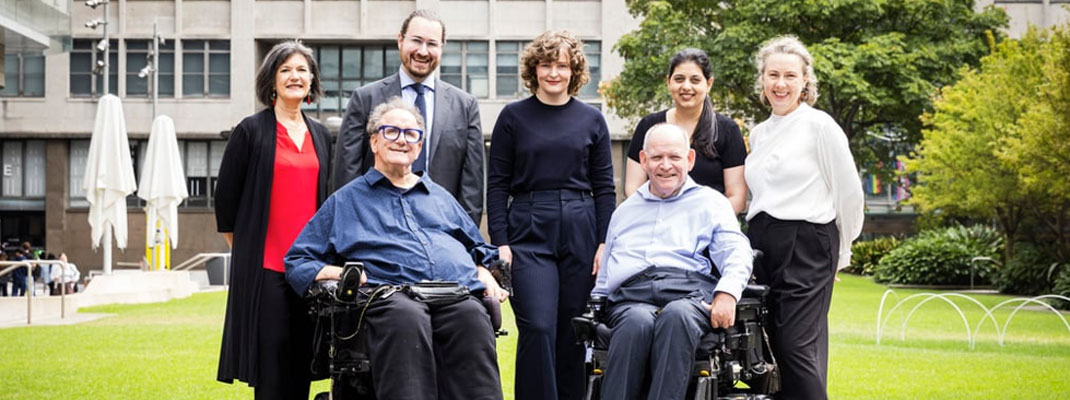
Photo of the Research team
Back (left to right): Barbara Almond (UTS), Edward Morris (Physical Disability Council NSW), Katherine Mackinnon (UTS), Farah Madon AM (Vista Access Architects), Professor Phillippa Carnemolla (UTS). Front (left to right): Professor Simon Darcy (UTS), Mark Relf (Accessibility Solutions). Image: Andy Roberts
Mark Relf AM and Farah Madon AM have contributed to an important University of Technology Sydney (UTS) research project investigating how accessible bathrooms can be designed around lived experience, real-world data and the diverse needs of people with disability.
This project was led by ACA member Professor Simon Darcy AM (UTS) and Professor Phillippa Carnemolla (UTS)
The University of Technology Sydney (UTS) has undertaken an important research project examining whether accessible bathrooms designed to meet Australian Standards actually work for the people who use them.
The Inclusive by Co-Design project brought together UTS researchers, wheelchair users, disability organisations and accessibility professionals to investigate the gap between minimum compliance and real-world usability. The research recognised that many current accessibility provisions are based on spatial assumptions and wheelchair models developed decades ago and may not adequately reflect the diversity of contemporary wheelchair users.
A key principle of the project was that people with disability should be directly involved in shaping the research. A survey of 209 participants generated approximately 27,000 words of qualitative feedback, with participants ranging from people who were fully independent to those requiring significant assistance. Sixty per cent used power wheelchairs and 55 per cent used manual wheelchairs, demonstrating the considerable diversity of mobility needs.
The researchers then took the investigation into real-world public bathrooms using an innovative portable research laboratory. The technology included 3D laser scanning, 360-degree photography, wheelchair movement tracking, eye-tracking glasses and biometric monitoring. This enabled the team to examine not just the physical dimensions of bathrooms, but how people actually moved through and interacted with them.
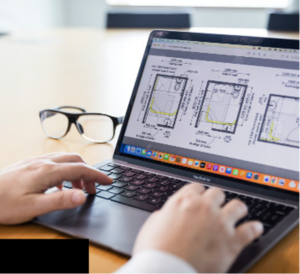
Image: Online survey of accessible toilets based on current standards (Image: Andy Roberts)
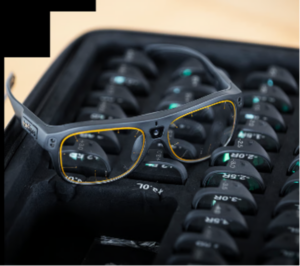
Image: Eye tracking glasses used by participants to understand how wheelchair users navigate the accessible toilet (Image: Andy Roberts)
The research identified a range of issues that conventional compliance assessments may not reveal. Participants frequently relied on toilet seats rather than grab rails during transfers, wheelchair seats were used to store personal and medical equipment, poorly positioned fixtures competed for space, and door locks were a significant concern. Interviews also highlighted the importance of cleanliness, maintenance, door operation, toilet height and floor gradients.
Importantly, the research demonstrated that wheelchair users are not a homogeneous group. Differences in strength, mobility, wheelchair dimensions, transfer techniques and personal equipment can significantly affect how a bathroom needs to function. A bathroom that works well for one person may not work for another.
The project reinforces the importance of moving beyond a purely compliance-based approach to accessibility and incorporating lived experience, evidence and co-design into the development of future standards and design practice.
Farah Madon AM of Vista Access Architects and Mark Relf AM of Accessibility Solutions (NSW) were industry members of the interdisciplinary research team, alongside researchers from UTS and representatives from disability organisations. The project has the potential to contribute to future improvements in Australian building standards and to influence more inclusive design across public buildings, homes, hospitals, schools and aged-care environments.